

Commentary
René Nyberg
{
  "authors": [
    "René Nyberg"
  ],
  "type": "commentary",
  "blog": "Carnegie Politika",
  "centerAffiliationAll": "",
  "centers": [
    "Carnegie Endowment for International Peace",
    "Carnegie Russia Eurasia Center"
  ],
  "englishNewsletterAll": "",
  "nonEnglishNewsletterAll": "",
  "primaryCenter": "Carnegie Russia Eurasia Center",
  "programAffiliation": "",
  "regions": [
    "Ukraine",
    "Russia"
  ],
  "topics": [
    "Foreign Policy"
  ]
}
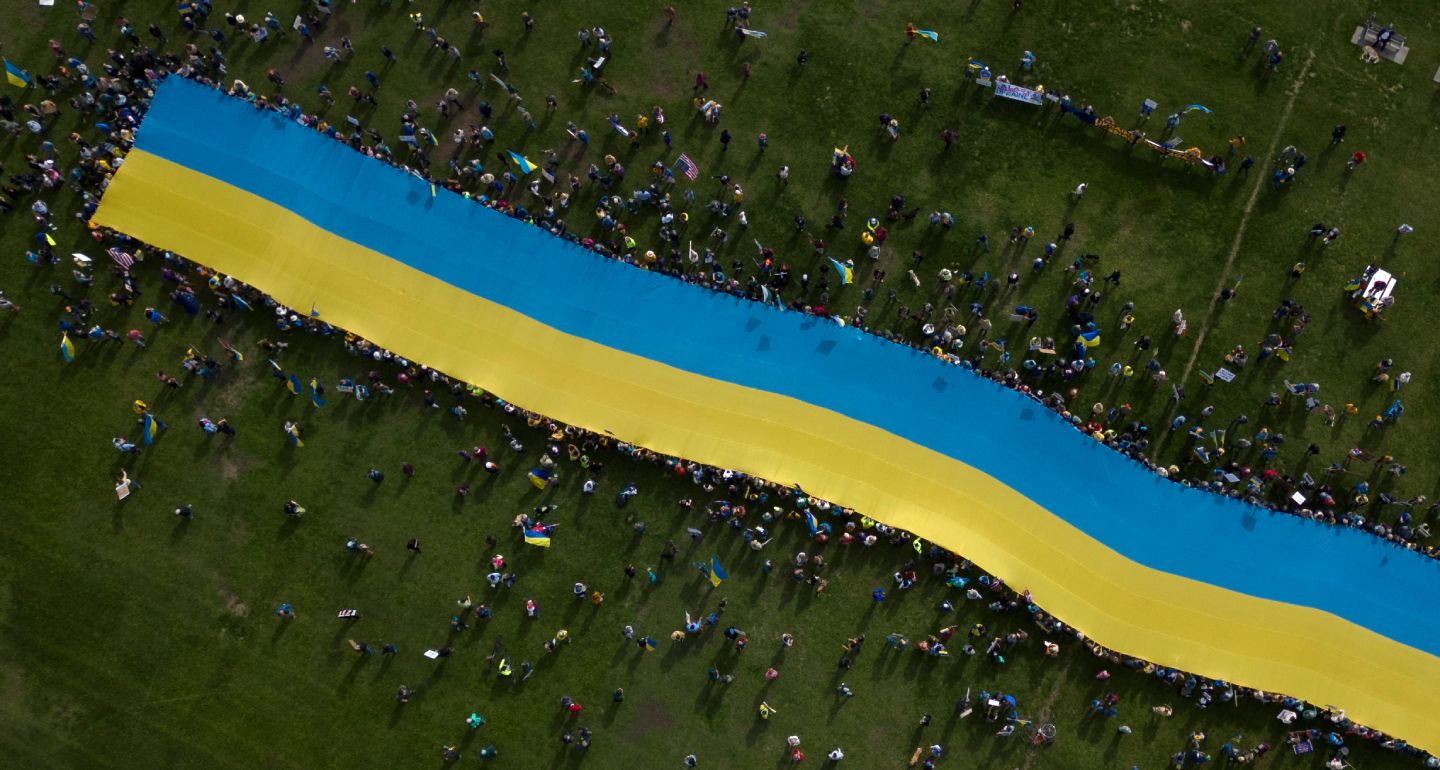
Source: Getty
The war does threaten Putin’s existence. That is why he does not negotiate.
Interest in Vladimir Lenin, who rests in his mausoleum in Moscow’s Red Square, is low these days, but one person has not forgotten him: Russian President Vladimir Putin. In Putin’s view, Ukraine’s plight is Lenin’s fault. The USSR’s 1922 constitution allowed the constituent republics to secede from the Union if they wished. Theory became reality when the Soviet Union collapsed in 1991 and all constituent republics, led by Ukraine, embarked on the path of independence.
Lenin’s gravest sin in Putin’s eyes was his nationality policy, which, by promoting cultural and linguistic development, laid the foundation for modern Ukraine. The so-called korenizatsiya, or indigenization, created the conditions for all minorities, including the Finnish speakers of Ingria and Karelia, to develop their own language and culture.
This was a radical change from the Great Russian chauvinism of the czarist era, which specifically denied the right of existence to the Ukrainian language. Later, everything changed when the Bolsheviks’ first Commissar for Nationalities, Joseph Stalin, returned to a harsh policy of Russification, which eased again in Ukraine after Stalin’s death.
Evidently, Putin loathes Lenin. Equally, he despises leaders who lost their empires, such as Nicholas II and Mikhail Gorbachev. The war in Ukraine is a matter of fate for Putin, as he does not want to end up among those who drove their empire to ruin. Ukraine is an obsession for him because it does not fit into his historical vision of a thousand-year-old Russia.
Admittedly, even Putin concedes that western Ukraine, which Stalin annexed to the Soviet Union, should belong to Poland and other neighboring states. The Russian president even made an offer to divide the spoils immediately after the full-scale war began in 2022. Otherwise, Putin has returned to Great Russian fundamentalism, which denies the very existence of Ukrainian identity.
Defending the rights of the Russian-speaking population of eastern Ukraine was one of the pretexts for the “special military operation,” i.e., Russia’s war of aggression. Behind Putin’s thinking is the view that without Ukraine, Russia is not an empire. And without its own sphere of influence, Russia is not Russia.
Putin’s systematic effort to restore the Kremlin’s lost control, both internally and externally, ran into difficulties, particularly in Ukraine. In the North Caucasus, restoring control using military force had gone better. Putin started the Second Chechen War as prime minister back in 1999. With the war, he wanted to restore honor to the Russian army, which it had lost in Boris Yeltsin’s humiliatingly concluded First Chechen War in 1994–1995.
Putin resolved the Chechen rebellion using the old method of the czars. He elevated a khan loyal to Moscow to power and paid him tribute, i.e., protection money, so that he would stay within his borders. This is what happened, and the Chechen capital Grozny, devastated by Russian artillery fire, is known today for its gleaming skyscrapers.
In Ukraine, however, the Kremlin ran into trouble. In November 2004, then prime minister Viktor Yanukovych, openly backed by Putin, managed to declare himself the winner of the second round of the presidential election, which was considered fraudulent. That led to widespread protests, but the situation was resolved bloodlessly with new elections, which resulted in a victory for Viktor Yushchenko.
The “third round” of the two-stage presidential election ended in humiliation for Putin. This series of events, known as the Orange Revolution, became a symbol of the so-called color revolutions and a permanent enemy image for Russia. Six years later, in 2010, Putin believed he could breathe a sigh of relief when Yanukovych was elected president.
However, the Kremlin suffered a major setback in 2014, when Ukrainians were enraged by Yanukovych backing down (under pressure from Moscow) from an association agreement negotiated with the EU. Kremlin propaganda went as far as to label the active foreign ministers in the EU negotiation process—Sweden’s Carl Bildt and Poland’s Radosław Sikorski—the “Poltava Coalition.” Yanukovych’s withdrawal from the agreement triggered the winter-long protests known as Euromaidan. The violent confrontation in Maidan Square in central Kyiv was an uprising that ultimately ended in regime change after Yanukovych fled to Russia.
The Kremlin’s countermove was the occupation of the Crimean Peninsula and an attempt by Russian-armed separatists to seize the whole of eastern Ukraine and cut off Ukraine’s access to the Black Sea. The plan succeeded only partially. Most of the Donbas ended up in the hands of the separatists. In contrast, the project known as Novorossiya failed because the seizure of Odesa fell through. Historically, Novorossiya refers to the Azov and Black Sea coastal region conquered from the Ottomans by Catherine the Great, from which the Novorossiya Governorate was formed.
The war in Ukraine has now lasted longer than both the USSR’s war with Hitler’s Germany and the First World War. The Bolsheviks’ first decision after the October 1917 coup was the “Decree on Peace,” because Lenin understood that the Russian peasant population longed for two things: peace and land. The Soviet government ordered the armed forces to cease hostilities. Those commanders who refused were dismissed and lynched by the soldiers. The Bolsheviks wanted to export the revolution to Germany and Europe and urged Russian soldiers to fraternize with the Germans.
Lenin’s and the Bolsheviks’ demand for peace still resonates. Russians long for peace, even if opinion polls claim otherwise. The cliché answer to the question of what is most important remains the same old one: “As long as there is no war” (Chtoby ne bylo voiny).
But how to stop the fighting and bombings? Ending a war that has entered its fifth year is unlikely to be possible without a change of power in the Kremlin, as power is tightly held by an authoritarian ruler who relies on an exceptionally strong apparatus of repression, secret police, and security services. Unlike in Ukraine, there is no civil society in Russia, and there are no longer influential and independent elites in the country.
By concentrating power in the presidential administration, Putin has effectively neutralized the oligarchs, who still held real power at the turn of the century. At no point has protection of property been guaranteed to them or other entrepreneurs. The message is clear: Ownership is conditional and dependent on the will of the Kremlin. By the same means, internal control of the media and the rest of society has been centralized in the Kremlin, step by step.
The current situation in Russia cannot be compared to 1917. There is no revolutionary situation. The pervasive presence and power of the secret police is historically unique. Although ending the war is on everyone’s mind, the war does not threaten Russia’s existence, and the Russian economy is not collapsing.
But the war does threaten Putin’s existence. That is why he does not negotiate. The deadlock is absolute. Projections into the future are useless. When power structures eventually fracture, an unknown and difficult-to-predict situation lies ahead. The only certainty is mutual deep hatred and bitterness between Ukrainians and Russians, for although the war is not a civil war, it is a brotherly war.
For Ukraine, the war is an existential question, and Ukraine will not surrender. Its collapse would lead to a flood of refugees, directed primarily toward Germany and Poland. Ukraine is also defending Europe. Lenin is not to blame for Ukraine’s plight. Instead, Putin has inadvertently become the father of the Ukrainian nation, just as Stalin united Finland after the 1939 attack by the Soviet Union.
The Finnish version of the text was published in Helsingin Sanomat on October 18, 2026.
Former Finnish Ambassador to Russia
René Nyberg is the former Finnish Ambassador to Russia.
Recent Work
René Nyberg
René Nyberg
Carnegie does not take institutional positions on public policy issues; the views represented herein are those of the author(s) and do not necessarily reflect the views of Carnegie, its staff, or its trustees.
Russia’s coveted Red Sea naval base has fallen victim to its erratic foreign policy.
Sergey Konyashin
Mikhail Zvinchuk’s detention could have dealt a serious blow to Russia’s propaganda infrastructure in the Balkans. Instead, the incident has made something else eminently clear: Moscow values and protects its propagandists, while Europe still hasn’t figured out what to do with them.
Ivan Filippov, Ksenia Luchenko
Latvia and Lithuania have been considering whether they could temporarily host NATO nuclear weapons in the event of war or a similar crisis.
Sergejs Potapkins
Russia does not have to treat Western companies as equal partners. A centralized regime built on a foundation of oil and gas income was never going to relinquish what it saw as sovereign control.
Edward C. Chow
The new Serbian leadership may have promised to keep on cooperating with Russia, but soon they will have to make a choice between fighting corruption and sealing lucrative deals with Moscow. The two are mutually exclusive, even if the new leaders in Belgrade haven’t yet realized it.
Maksim Samorukov