

Commentary
Thomas de Waal
{
  "authors": [
    "Thomas de Waal"
  ],
  "type": "commentary",
  "blog": "Strategic Europe",
  "centerAffiliationAll": "",
  "centers": [
    "Carnegie Endowment for International Peace",
    "Carnegie Europe"
  ],
  "collections": [
    "Europe’s Eastern Neighborhood",
    "EU Integration and Enlargement",
    "Aso Tavitian Initiative"
  ],
  "englishNewsletterAll": "",
  "nonEnglishNewsletterAll": "",
  "primaryCenter": "Carnegie Europe",
  "programAffiliation": "",
  "programs": [],
  "projects": [],
  "regions": [
    "Russia",
    "Europe",
    "Eastern Europe",
    "Caucasus",
    "Azerbaijan",
    "Armenia"
  ],
  "topics": [
    "Security",
    "Economy",
    "EU",
    "Foreign Policy"
  ]
}
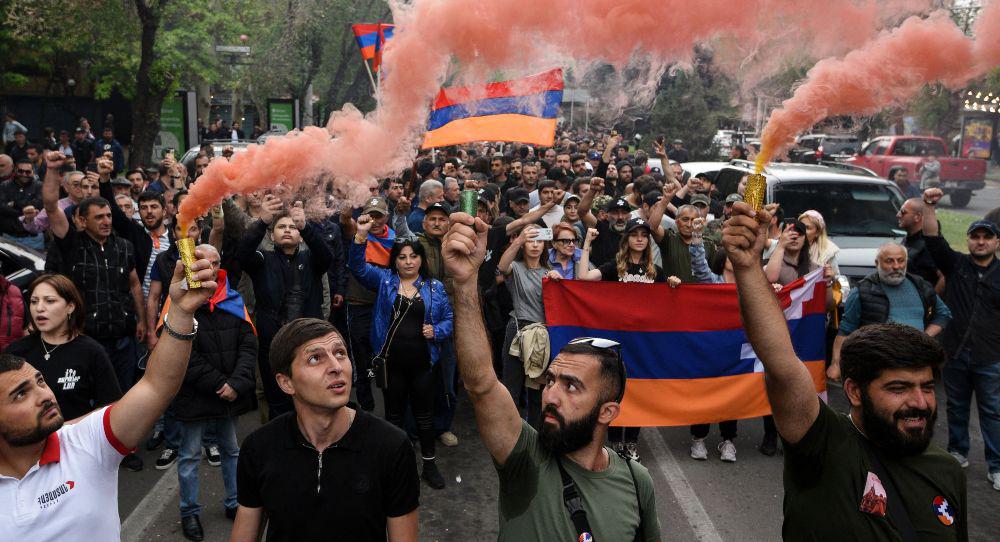
Source: Getty
Prime Minister Pashinyan is taking risks to address his country’s long-running disputes and overdependence on Russia. But much of what happens next depends on Azerbaijan.
It is going to be a long, hard year not just for Ukraine but for a line of former Soviet republics in the neighborhood of Russia and the EU.
Armenia is near the top of the list. It’s still in a state of semi-permanent crisis that predates Russia’s war on Ukraine. Defeat to Azerbaijan in the 2020 war left Armenians feeling vulnerable as never before, and Azerbaijani President Ilham Aliyev has kept up the pressure remorselessly since then. In an International Republican Institute (IRI) poll from last summer, 54 percent of Armenians said national security was their biggest concern, far ahead of domestic and economic issues.
There are some bleak scenarios for how 2023 could end: more violence with Azerbaijan, pressure from Russia, and domestic political turmoil. There are also rosier ones: strengthened relations with the EU, progress in normalizing relations with Türkiye, and a framework agreement with Baku that begins to resolve a decades-old conflict, opens borders, and consolidates the sovereignty of Armenia and Azerbaijan.
Armenian Prime Minister Nikol Pashinyan is still at the epicenter of this turmoil. He came to office on a wave of euphoria in the peaceful Velvet Revolution of 2018. He was an unwilling—and ineffective—war leader in 2020. But he was reelected in 2021, more or less by default, with a less inspiring message and largely because the main opposition candidates were much more unpalatable to Armenian voters. Despite big promises in 2018, his domestic record is still quite patchy, with major reforms of the judiciary and media ownership still overdue.
Yet Pashinyan is still a revolutionary—in foreign policy matters. He has gone out on a limb to advance the normalization of relations with Türkiye, despite Ankara’s support for Azerbaijan in the 2020 war, and public antipathy—in the same IRI poll, 59 percent of respondents were negative about normalizing relations with Türkiye, 28 percent said they were in favor.
Pashinyan is open about his unease with Armenia’s military and economic reliance on Russia. He publicly questions the utility of the Russian-led Collective Security Treaty Organization, of which Armenia is a part, despite rumblings of dissatisfaction from Moscow and menacing talk from Belarusian leader Alexander Lukashenko.
Pashinyan has reached out to Western partners repeatedly and has now received a European Union monitoring mission on Armenia’s border with Azerbaijan with a two-year mandate, incurring the displeasure of the Russian Foreign Ministry in the process.
The risk-taker Pashinyan also remains committed to a negotiating process with Azerbaijan, in the teeth of much dissent in Yerevan. He does so even despite the current crisis over Nagorny Karabakh: since December 12, 2022, Azerbaijani government-backed protestors have shut down the so-called Lachin Corridor linking Armenia and the Armenian-majority enclave of Nagorny Karabakh. In Karabakh itself the shops are empty, kindergartens are closed, supplies are running low.
A deal to end the crisis may be in the offing. Last week, the International Court of Justice ordered Azerbaijan to keep the road open.
Both leaders found common cause in wanting to see the removal of the well-connected Russian-Armenian businessman Ruben Vardanyan from a top position in Karabakh. Vardanyan was dismissed by the Karabakh’s de facto president on February 23, 2023. Several other things need to happen before the road can re-open—Russia will also have its say—but it now looks a few steps closer.
If that happens, Pashinyan and Aliyev can resume the EU-sponsored talks that were suspended in December. The talks, chaired by European Council President Charles Michel, went much further than most expected and the EU is accepted as an honest broker, unlike Moscow—and without some of the baggage carried by Washington.
A proper Armenia-Azerbaijan peace agreement, talked up last year by President Aliyev, will still be hard to achieve. The future of Karabakh is still contested. The Armenian side is highly suspicious of Azerbaijani intentions, in the wake of the latest Karabakh crisis, cross-border incursions last year which cost several hundred lives, and irredentist rhetoric by Aliyev.
The Azerbaijani side makes its own complaints, dating back to the years when the Armenian side was in the dominant position in the conflict, saying the Armenians are dragging their feet and are not serious about clinching a deal.
The outlook on Türkiye is better—if for tragic reasons. The horrendous February 6 earthquake allowed for the opening of the Armenian-Turkish land border for the first time in almost thirty years as an Armenian humanitarian convoy traveled to the earthquake zone. Türkiye’s envoy for negotiations with Armenia publicly welcomed the aid and Armenian foreign minister Ararat Mirzoyan then traveled to Türkiye. On March 25, when the Turkish football team travels to Yerevan for a European qualifier match, there will be a chance to repeat the football diplomacy that kicked off normalization talks in 2008.
Not much is expected to happen before Türkiye’s big elections in the summer, but when that is over, the prospects look good. If the opposition manages to win the election in Türkiye there is a good chance that they will press ahead with normalization with Armenia as being in the country’s state interest and will be less inclined to allow Azerbaijan to exercise a veto. That would be a vindication for Pashinyan’s strategy.
Everything in Armenia at the moment is a matter of security. Pashinyan is exposing himself to strong political dissent—potentially even political violence—by his actions. There are many who wish for him to fail, in Russia and in parts of the Armenian diaspora.
The EU and the United States can help by offering support for Armenia’s sovereignty and economy, and by underwriting an equitable peace process.
But much of what happens is out of Armenia’s hands and depends on decisions taken by Azerbaijan, Russia, and Türkiye—Azerbaijan, perhaps, above all. The single most important thing that would help relieve Armenia’s insecurity and overdependence on Russia would be Azerbaijan easing the pressure and moving to a language of cooperation, not confrontation.
President Aliyev’s reluctance to turn the page has a lot more to do with the past than the present. The decisions he makes in the next few months will be highly consequential.

Senior Fellow, Carnegie Europe
Thomas de Waal is a senior fellow at Carnegie Europe, specializing in Eastern Europe and the Caucasus.
Recent Work
Thomas de Waal


Thomas de Waal, Areg Kochinyan, Zaur Shiriyev
Carnegie does not take institutional positions on public policy issues; the views represented herein are those of the author(s) and do not necessarily reflect the views of Carnegie, its staff, or its trustees.
The battle over free speech has taken center stage since U.S. Vice President JD Vance accused Europe of censorship. From travel bans to social media regulation, especially around the Israel-Palestine conflict, are liberal democratic governments weaponizing free speech?

Rym Momtaz, ed.
Europe seems to have accepted its sidelining in the Middle East. The EU must reassert its support for the international rules-based order and step up engagement.
Rym Momtaz
Amid uncertainty caused by the Iran war, the global drive for nonproliferation has stalled. With Europe diplomatically marginalized and countries reassessing their nuclear options, efforts to curb the spread of nuclear weapons risk becoming irrelevant.

Jane Darby Menton
Preparing candidate countries for EU membership is no longer enough. As the enlargement process becomes a reality, the union must also prepare its own societies.

Iliriana Gjoni
Five countries staged the biggest political boycott in Eurovision history over Israel’s participation. With the FIFA World Cup and other sporting or cultural touchstones on the horizon, are boycotts effective?
Rym Momtaz, ed.